
Introduction
qbrix is an adaptive optimization engine delivered as a cloud service. It separates the hot path (variant selection) from the learning path (training) to achieve ultra-low latency decisions with eventual consistency in parameter updates.
Architecture
qbrix is composed of three services, two data stores, and a message queue:
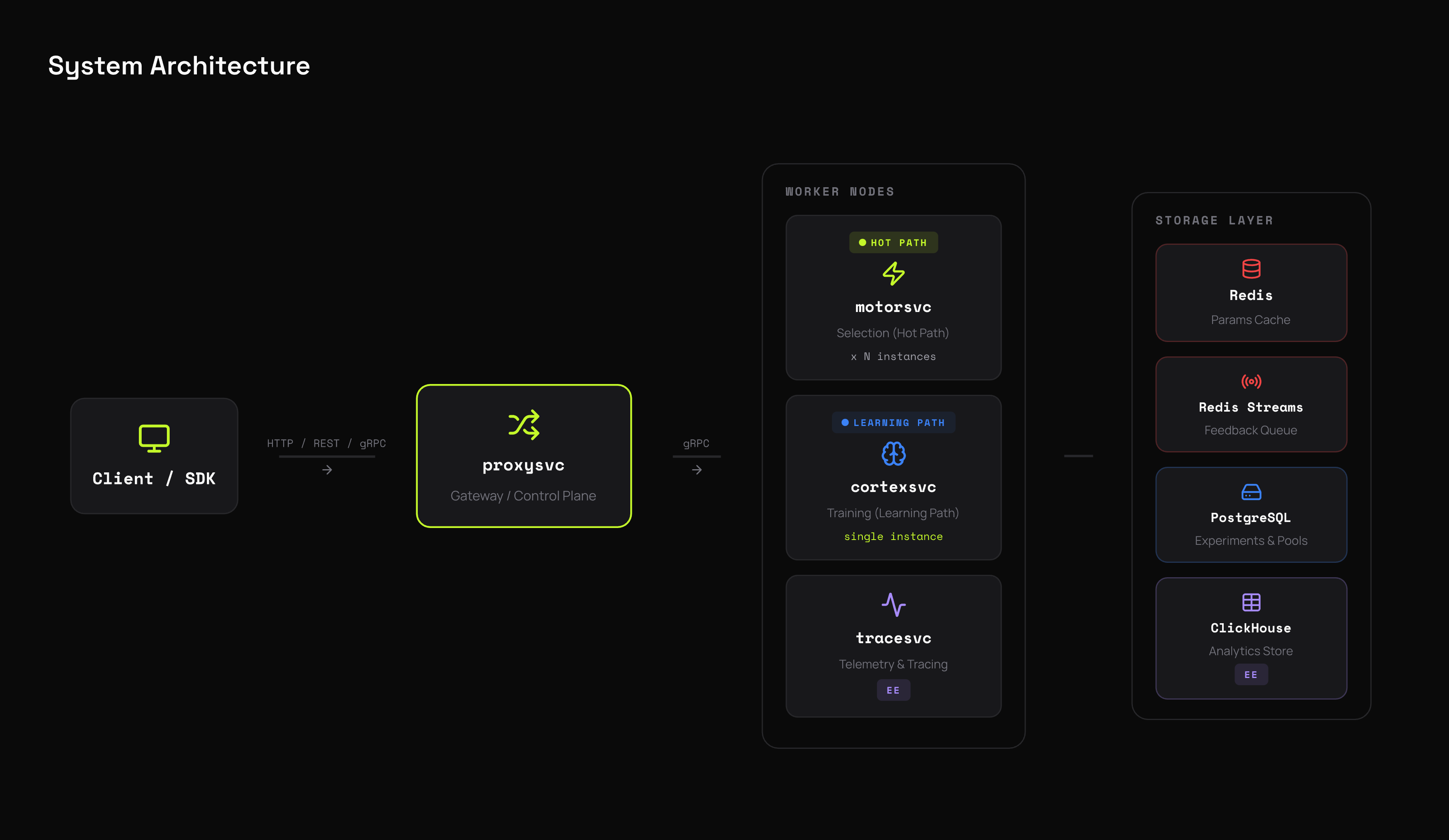
| Service | Role |
|---|---|
| proxysvc | Gateway — HTTP/REST + gRPC entry point, auth, experiment management, feature gates |
| motorsvc | Selection — stateless, horizontally scalable, reads cached params |
| cortexsvc | Training — single instance, batch training via Redis Streams |
For a deep dive into service internals, caching layers, and performance optimizations, see Architecture.
Key Concepts
| Concept | Description |
|---|---|
| Pool | A named collection of arms (variants). For example, a pool of homepage hero images. |
| Arm | A single variant within a pool. Each arm has an index, a name, and optional metadata. |
| Experiment | Links a pool to a policy (algorithm). Defines how arms are selected and trained. |
| Policy | The algorithm qbrix uses to decide which variant to serve — and how it learns from each outcome. Available across stochastic, contextual, and adversarial categories, plus an auto mode that runs a portfolio of learners and adaptively routes traffic to the best performer. |
| Feature Gate | Controls experiment traffic with rollout percentages, scheduling, and targeting rules. |
| Feedback | A reward signal sent after selection. Used by cortexsvc to update policy parameters. |
| Context | Optional request-level information (user features, metadata) used by contextual policies. |
Request Flow
- Sign up at cloud.qbrix.io and create an API key
- Create a pool with arms via the API or console
- Create an experiment linking the pool to a policy
- Integrate select and feedback API calls in your application
- Monitor and optimize via the console dashboard
What's Next
- Features — everything qbrix ships out of the box
- Architecture — system design, performance, and reliability
- Quickstart — create your first experiment in minutes
- Pools & Experiments — data model and lifecycle
- Feedback & Rewards — the learning loop
- API Reference — full HTTP endpoint documentation
- Policies — the algorithms behind every decision, and how to choose one